By Raimundo Oliveira April 3, 2026
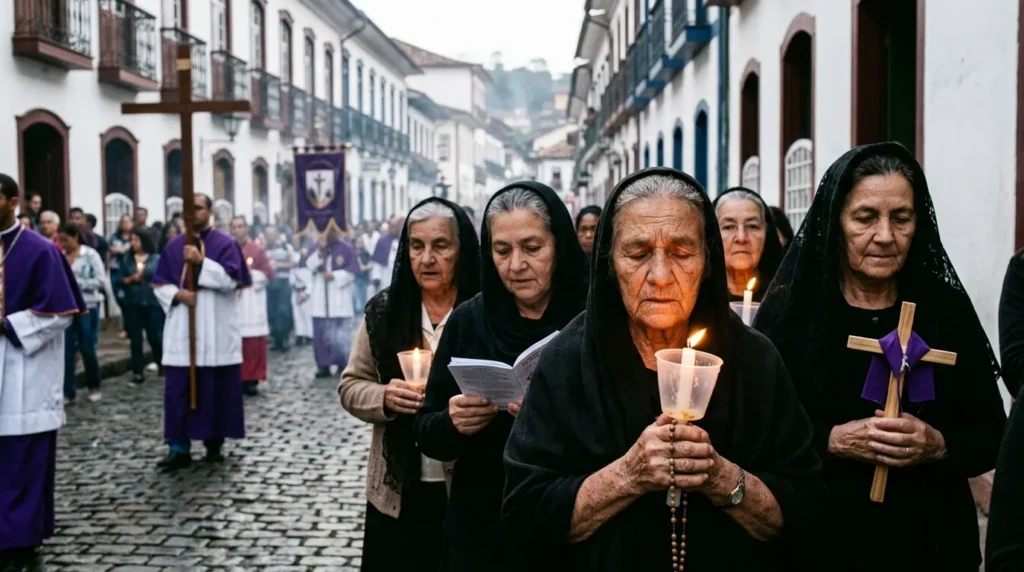
OURO PRETO, Brazil — Under the weight of centuries-old wooden statues and the lingering scent of incense and basil, the cobblestone slopes of Minas Gerais have once again become the epicenter of one of the Western Hemisphere’s most vivid displays of devotion. In Brazil, Semana Santa (Holy Week) is not merely a religious holiday; it is a cultural kaleidoscope where Portuguese colonial heritage merges with the rhythmic vivacity of the Brazilian soul.
A Carpet of Colors and Devotion
In the early morning hours of Sunday, as mist still clung to the mountains, residents of historic towns like Ouro Preto and São João del-Rei poured onto the streets to create the famous “devotional carpets.” Made of colored sawdust, sand, and fresh flowers, these ephemeral murals stretch for miles, serving as a sacred path for the processions to follow.
“It is an art form that lasts only a few hours, but the preparation takes the entire year,” says Maria Helena dos Santos, 72, who has coordinated the carpet-making on her street for four decades. “We aren’t just decorating the ground; we are paving our faith.”
The Spectacle of the Backlands
While the Southeast focuses on Baroque tradition, the Brazilian Northeast offers a spectacle of cinematic proportions. In Nova Jerusalém, in the state of Pernambuco, the world’s largest open-air theater stages the “Passion of Christ.” Featuring walls that mimic ancient Jerusalem, the production draws thousands of tourists, transforming the arid sertão into a stage for biblical drama and modern special effects.
Fasting and Gastronomy
The abstinence from red meat—a tradition still strictly observed by millions of Brazilians—has given rise to a unique Lenten cuisine:
- Bacalhau: A direct legacy from Portugal, served with potatoes and generous amounts of olive oil.
- Vatapá and Moqueca: Along the Bahian coast, devotion takes on the flavor of dendê (palm oil) and coconut milk.
- Easter Eggs: Brazil boasts one of the world’s largest chocolate markets, where the exchange of artisanal eggs has become a social rite of passage, often eclipsing religious significance for younger generations.
Faith in Modern Times
Although Brazil remains the world’s largest Catholic nation, Holy Week 2026 reflects a shifting religious landscape. The growth of evangelical churches and urban secularization has transformed the holiday. For many, Semana Santa is now synonymous with crowded beaches and congested airports, highlighting a growing tension between spiritual retreat and mass leisure.
Yet, when the bronze church bells toll in unison on Good Friday, the country seems, for a moment, to hold its breath. Whether driven by religious fervor or respect for tradition, Brazil proves that its deep roots are still capable of sustaining a spectacle of faith unparalleled in the modern world.
Follow our full coverage of global Easter celebrations in our Religion and Culture section.